
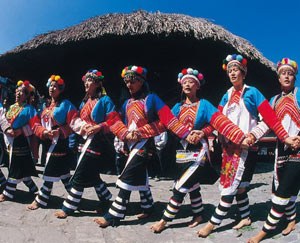
About Aborigines
Amis
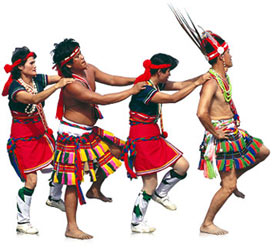 The Amis are an indigenous people of Taiwan. They speak an Austronesian language and are one of the thirteen officially recognized peoples of Taiwanese aborigines. The traditional territory of the Amis include the long, narrow valley between the Central Mountains and the Coastal Mountains, the Pacific coastal plain eastern to the Coastal Mountains, and the Hengchun Peninsula.
In the year 2000 the Ami numbered 148,992. This was approximately 37.5% of Taiwan's total indigenous population, making them the largest tribal group. The Amis are primarily fishermen due to their coastal location. They are traditionally matrilineal. Traditional Amis villages were relatively large for indigenous groups, typically between 500 and 1,000. In today's Taiwan, the Amis also comprise the majority of "urban aboriginals" and have developed many "urban tribes" all around the island.
Bunun
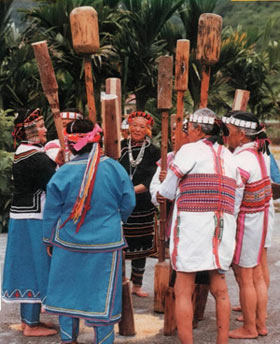 The Bunun are a tribe of Taiwanese aborigines and are best-known for their sophisticated polyphonic vocal music. They speak the Bunun language. Unlike other aboriginal tribes in Taiwan, the Bunun are widely dispersed across the island. In the year 2000 the Bunun numbered 41,038. This was approximately 10% of Taiwan's total indigenous population, making them the fourth-largest tribal group. They have five distinct sub-tribes: the Takbunuaz, the Takituduh, the Takibaka, the Takivatan, and the Isbukun.
Sakizaya
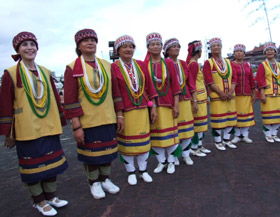 The Sakizaya are Taiwanese Aborigines with a population of approximately 5,000–10,000. They primarily live in the counties of Keelung, Taoyuan, Taipei, and Hualien.
The Sakizaya are an Austronesian people, mostly related to other Taiwanese Aborigines but also have cultural, linguistic, and genetic ties to other Austronesian ethnic groups, such as those from the Philippines, Malaysia, Indonesia, Madagascar, and Oceania. Though their language is their most defining feature, it has not been recognized as a "true language" but simply a dialect of Amis, even though both languages are not grammatically similar.
The Sakizaya are Taiwanese Aborigines with a population of approximately 5,000–10,000. They primarily live in the counties of Keelung, Taoyuan, Taipei, and Hualien.
The Sakizaya are an Austronesian people, mostly related to other Taiwanese Aborigines but also have cultural, linguistic, and genetic ties to other Austronesian ethnic groups, such as those from the Philippines, Malaysia, Indonesia, Madagascar, and Oceania. Though their language is their most defining feature, it has not been recognized as a "true language" but simply a dialect of Amis, even though both languages are not grammatically similar.
Most Sakizaya practice ancestor worship, which includes the worship of a pantheon of gods and ancestral spirits. Their society is mostly matrilinear, and women often have the authority. On January 17, 2007, the tribe satisfied the Taiwanese government's requirements for full tribal status. Prior to this, the tribe was previously classified as Amis, the tribe where they "hid" after they, and their Kavalan allies, fought a devastating battle against Qing invaders during the late 19th century.