
Music
Sound
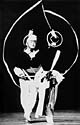 According to ethno musicalist, Keith Howard, Ph.D., the "music of SamuINori belongs primarily to
the world of farmers' bands (nong-ak), a folk tradition central to the Korean heritage. It has
often been said that nong-ak captures the spirit of all that is Korea, with a documented history
beginning back in the third century with Chen Suo's San Kuo Chih:
According to ethno musicalist, Keith Howard, Ph.D., the "music of SamuINori belongs primarily to
the world of farmers' bands (nong-ak), a folk tradition central to the Korean heritage. It has
often been said that nong-ak captures the spirit of all that is Korea, with a documented history
beginning back in the third century with Chen Suo's San Kuo Chih:
In Mahan the people held a festival to honor God at the time
of sowing in May and of harvesting in October. All of them assembled together, enjoyed singing and dancing
day and night without pause, forming lines, circling around, stamping on the ground and clapping their
hands according to set rhythms.
"(Not that we could suggest that the music has remained similar over time.) A polysomic history encompassing
military, farming, ritual, and entertainment elements, nong-ak has been described variously. It was
'pagan' to early missionaries, 'primeval' to some social scientists, and the 'basis of indigenous music
systems' to one or two enlightened music scholars. The group combines traditional rhythmic constructs
derived from local farmers' bands and traveling troupes with shamanistic ceremonies and modern compositions
and thus stand at a musical crossroads where rural and urban traditions and east and west meet in a synthesis
of music and dance. For this reason they are both traditional and contemporary.
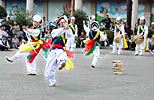 "They 'don't play like we used to' say the islanders to the south of the Korean peninsula and 'that's
not nearly what I taught them' according to Kim Pyong-sop, in reference to their version of nong-ak.
Change has clearly happened. P'an Kut traditionally referred to as a type of entertainment given in a local
gathering place, either by a local band during a village ritual, or by a touring group.
Pinari, a type of prayer, was traditionally given by invited musicians or
shamanistic practitioners to promote health and prosperity amongst a family, or to ensure spiritual
support for a building project. But the folk religious world to which P'an Kut
and Pinari belong is dying: today few villages maintain bands, even fewer hold annual P'an Kut, and
itinerant traveling troupes have disappeared."
"They 'don't play like we used to' say the islanders to the south of the Korean peninsula and 'that's
not nearly what I taught them' according to Kim Pyong-sop, in reference to their version of nong-ak.
Change has clearly happened. P'an Kut traditionally referred to as a type of entertainment given in a local
gathering place, either by a local band during a village ritual, or by a touring group.
Pinari, a type of prayer, was traditionally given by invited musicians or
shamanistic practitioners to promote health and prosperity amongst a family, or to ensure spiritual
support for a building project. But the folk religious world to which P'an Kut
and Pinari belong is dying: today few villages maintain bands, even fewer hold annual P'an Kut, and
itinerant traveling troupes have disappeared."
Dr. Howard offers some of his own comments, "The music has moved from the world of ritual to
entertainment. Today in Korea, mass entertainment channels and 'airport art' provided for businessmen
and tourists present large groups of pretty, young dancers who give simple, repetitive patterns from
nong-ak in an ever-smiling environment. But Samulnori has chosen
rather a re-interpretation of the past in a specialized, thoroughly professional present. Complexity
has been added to the simplest music, which leads to a world of rich, dramatic contrast. Silence gives
way to a mesmeric telling of the gong, slow thuds on a drum accelerate to shrill pitched rapid strikes.
Climaxes are built and subside peacefully waves. Samulnori thus provide a
blend of old and new."
Lightning, Wind, Rain, Cloud
SamulNori's music is based on the rhythms of traditional Korean folk percussion music. The name
SamulNori literally means "To play Four Things." Those four things refer to the four
percussive instruments, which it turn represent four respective elements of weather:
The kwaenggwari refers to a small gong, made mainly of brass,
with trace of gold or silver. It is hand held and played with a bamboo mallet. One hand holds the
mallet while the other hand is responsible for dampening the sound produced. The player of this
instrument often plays the role of leader, signalling transitions in the music. As each instrument
is associated with an element in nature, the K'kwaenggwari relates to lightening.
The jing is a large gong that is struck with a padded stick. This
instrument can be played in a number of ways: hung on a frame, hand-held by a handle, or played with
two hands. A jing should make an occilating sound, imitating the shape of Korean valleys. This
instrument is associated with the wind.
The janggu is often called the hourglass drum, referring to its shape
which is similar to an hourglass. The drum has two sides, each with a different type of leather skin.
One side produces a high-pitched sound. This instrument is associated with rain.
The buk is a barrel drum, made of a piece of hollowed out wood and two
leather skins tied to the wood. It is played by a single stick and provides the bass sounds of the
group. The buk is related to the clouds.