
What is Samul nori?
Definition
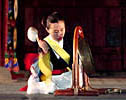
The music of Samulnori traces its roots to traditional music in several different contexts. In Nong-ak (farmers' music), professional bands of 24 or more performers perform. They usually include eight musicians playing instruments, eight dancers performing on hand-held drums (sogo), and eight actors who mimic various characters and the T'aep'yongso (conical oboe) players. The musicians in a Nong-ak band performed with Samul, the same four instruments (kwaengwari, jing, janggu, and buk) that Samulnori musicians use.
 |
 |
 |
 |
| kwaengwari | Jing | Janggu | Buk |
Samulnori, the music that managed to dominate the Korean music world in
the 1980s, can be described as the transformation of Nong-ak (which is performed outdoors)
into a form suitable for the modern stage. The repertoire which the group has made standard over the years also provides good evidence that the group's
origins come from Nong-ak, while its stage performance form comes from Anjunban,
rather than the nonstop drumming and dancing of Nong-ak.
However one wishes to trace its origins, wherever its performance style takes its inspiration and
no matter what terms we use to describe its inner character, the important point is that the music
of Samunori has had a tremendous impaction on modern Korean music history, especially during
the '80s. Kim Duk Soo's Samulnori
has been responsible for an epoch with a major impact on Korean music. The impression that the group
has made has been described as shocking and irresistible as the force of a sudden gust of wind. The
ensemble has covered six continents in their travels. And for those whose sensibilities have become
somewhat jaded, Samulnori has provided a fresh and startling impulse.
Over 1,000 performances at home and abroad and the production of 16 albums have been the result of
the group's global vibrations.